
About us
“Media Tenor is nothing other than a compass.”
Roland Schatz, founder of Media Tenor
Since 1994, Media Tenor has analysed what the media report on and how they report it. Every story, not just samples. The data is open to researchers and journalists and helps organisations steer their communication.

“Our data is collected as objectively as humanly possible.”

Roland Schatz
Founder and CEO of Media Tenor International and InnoVatio Publishing. A fifth-generation journalist who has spent more than 30 years making perception verifiable through media analysis.
Why we founded Media Tenor
Hostility towards the media
The idea behind Media Tenor was a non-profit one: in 1994, the Media Tenor association was founded under the umbrella of the Innovatio publishing house, itself established in the mid-1980s. The trigger was hostility towards media houses from politicians and their push for stricter press laws (e.g. the “Lex Lafontaine”). Media Tenor was to examine whether the criticism of newspapers and television programmes had any empirical basis at all.
Our standard: complete analysis
The practice, common well beyond communication science, of relying on the analysis of samples always struck founder Roland Schatz as highly suspect, because you can only make statements once you have analysed everything. “I would never dream of playing a Beethoven concerto with only my left hand,” Schatz told the German newspaper WELT.
Our purpose: the public good
But research is expensive: “Everyone wanted the data, but nobody wanted to pay,” says Schatz. This ultimately led to the founding of the company, whose data is still largely made available to academics and journalists free of charge. Commissioned work for companies still serves above all to finance the public work.
“Economic narratives conveyed by the media are crucial for understanding current fertility trends”
Daniele Vignoli, Raffaele Guetto, Maria Francesca Morabito, University of Florence
Research with Media Tenor data
Demography · 2023
Fertility and Media Narratives of the Economy
Raffaele Guetto, Maria Francesca Morabito, Matthias Vollbracht, Daniele Vignoli
Abstract
The article examines the view that economic narratives conveyed by the media are crucial for understanding current fertility dynamics, beyond objective economic constraints. Individuals use these narratives to project themselves into an actionable imagined future and to make decisions that can be relatively independent of their actual economic situation. This hypothesis is tested for Italy by combining individual-level data from the 2009 and 2016 waves of the nationally representative “Family and Social Subjects Survey” with Media Tenor data on economic coverage in the evening news of Italy’s most-watched television channel (Rai 1). Our results show that both the frequency and the tone of news reports on the economy are related to fertility behaviour. An increase in negative economic news is negatively associated with fertility, while an increase in positive news is positively associated with it. Interestingly, when positive news outweighs negative news, a rise in the share of economic reports is positively associated with fertility. These associations are statistically significant and substantively relevant, even after controlling for traditional individual and contextual socio-economic correlates of fertility. Overall, our results support the thesis that media narratives about the economy influence fertility behaviour.
Global Finance Journal
ESG, Corporate News, and the Impact on CDS Spreads
Hans-Jörg Naumer, Burcin Yurtoglu
Abstract
The study examines the impact of corporate news on the financing costs of a sample of large European and US companies between 2006 and 2016. It focuses on news about environmental, social and governance (ESG) issues and takes into account volume (number of news items), tone (positive, neutral, negative) and source (financial media or mass media). The results show that (1) the volume of ESG-related news is significantly correlated with credit default swap (CDS) spreads and therefore matters for companies’ refinancing costs; (2) news with a positive (negative) tone is associated with CDS spreads that are around 4% (6%) lower (higher); (3) tone plays an even greater role in ESG-related news. These results hold across different subsamples and alternative specifications and are relatively insensitive to omitted variables.
DEval · 2021
Opinion Monitor for Development Policy 2021
German Institute for Development Evaluation
Media content, information, appeals and their impact on public opinion.
“Every corporation has to be aware of the importance of the so called agenda-setting media. They can kill your reputation in a second.”
Emilio Galli-Zugaro, former Head Communications Allianz SE
Reputation management
Crossing the perception threshold
Even in the age of social media, the most effective way to reach your target audience is still through the media. Being present is not enough; communication has to be designed so that it crosses the perception threshold. Only then can you expect your target audience to act. This is backed by scientific studies.
Making media relations measurable
MEDIA TENOR makes the media relations of organisations measurable. Its academically trained analysts filter out the relevant information and translate media messages into actionable measures for communication and management.
From knowledge to decisions
MEDIA TENOR helps turn strategic knowledge into tactical decisions: your compass for monitoring and steering external communication, nationally and internationally.
Reputation and Its Risks
Eccles, Newquist, Schatz · Harvard Business Review

CEO Impact Index
How the media shape the image of chief executives
“The press may not be successful much of the time in telling people what to think, but it is stunningly successful in telling its readers what to think about.”
Bernard Cohen
Agenda-setting research
A focus from day one
Since its inception, MEDIA TENOR has worked intensively on research into the agenda-setting theory of Maxwell E. McCombs and Donald L. Shaw (The agenda-setting function of mass media).
The ICA=CH model
With the ICA=CH approach, MEDIA TENOR has established its own applied model of media effects research.
From news to behaviour
It measures and explains how real-world developments are translated through media coverage into public perception and ultimately into attitudes and behaviour – not merely as a theoretical effect, but traceably, based on data.
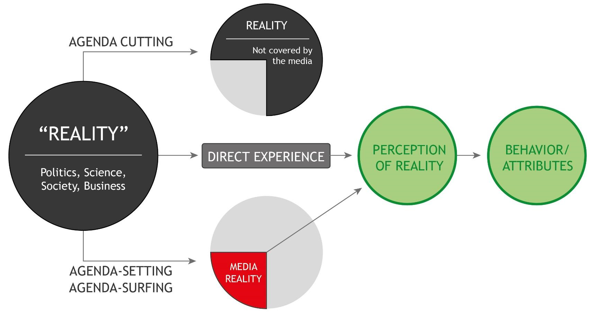
Effects theory: the agenda-setting approach
Corporate management increasingly demands proof that investments in communication have an effect. Agenda-setting theory provides answers on the role of the media: (1) channelling attention and (2) steering expectations.
Source: Media Tenor 2016
Media Tenor in research and the media
We collect academic work based on our data, and coverage of our analyses, in dedicated overviews with links to the original sources.
Explore further
What do you need to understand?
Talk to us about your question.